
If you’ve spent a while in the fitness section of the internet or in the gym, you might think you’ve seen everything there is to see about muscle-building.
It’s one of the most popular topics on any fitness blog, and with good reason: building muscle is great for your appearance, confidence, health and strength.
What you probably haven’t seen are the real cutting-edge secrets to building the most muscle possible. That’s what this article is about: advice on building muscle that you won’t see on the cover of health magazines!
We will cover all you need to know about hypertrophy training: definition; importance and benefits for muscle-building; training examples with sets and reps numbers. Let’s get to work!
Stretch First
What’s a Stretching Exercise?
Stretching exercises are basically any movements that are going to require you to move through the full range of motion of a muscle/joint while under load.
This isn’t about mobilizing. It’s about putting your stretching and lengthening exercises before the pressing ones. Simply put, this means slow lengthening exercises like flyes and lunges before shorter, pressing exercises like benches or squats.
(Read more about prehab and stretching before and after working out)
Simply pick something that is a long movement and provides you with a stretching sensation to start each workout.
The Romanian deadlift or deficit Bulgarian split squat (like a regular split squat, but the front foot is elevated) are great lower-body examples.
Putting dumbbell flyes before your bench press is also a great way to increase the muscle-building effect of your workout. This applies double if you focus on a slow, controlled stretch for many repetitions using a lighter weight.

This is because stretching the muscle with an exercise like the fly lengthens the muscle, prepares it for exercise, and begins the muscle protein damage rapidly. You have to cause more stress to see more results and this approach does it rapidly.
Flyes are a really obvious example of this, but you can also find examples in the lower body, core and other areas.
Eccentric Hypertrophy Training Definition
One of the most interesting trends is that eccentric training has been mostly overlooked despite being the most effective way of building muscle using weights.
What’s Eccentric Training?
Slow-eccentrics are all about focusing on the lowering portion of the movement. This is the part of the movement that science says you’re going to do the most damage to the muscle (in a positive way!). In slow-eccentric, you do the concentric portion at maximum speed, then go slow for the eccentric- lower it slowly, then lift it explosively, but under control.
Slow Down!
Slowing down the eccentric part of the lift is also a key way to improve power output and reduce the risk of injury to your joints. These are great benefits, above and beyond the fact they’re going to make you bigger and stronger!
You can use eccentric training for any rep scheme, but it applies most effectively to strength/power training. Using slow-eccentric training on heavy weights in the 1-5 rep range is going to maximally improve your strength and power output, as well as boosting muscle mass significantly.

You can also use slow-eccentrics in combination with stretching exercises to ensure maximum results. One of our favorite uses is to slowly perform stretching exercises, followed by slow-eccentric power/strength exercises to capitalze on both adaptations – getting bigger and stronger at the same time!
Rep Scheme Variety
New research is starting to show that the way that you train has more of an effect on the outcomes of your muscle growth. Even with everything we’ve discussed so far, there are more great, under-used training methods you should be implementing.
Add Variety
You can also gain muscle by having more rep-variety between your sets (according to a forthcoming study).
This means that you’re going to experience better muscle gains if you use sets of 5/10/15 reps than if you’re using sets of 8/10/12 when you control for weight.
Either way, you’ll do 30 reps in total, but 5/10/15 will yield greater gains.
By hitting all the different rep ranges, you boost the number of muscle fibers you’re hitting and ensure the best result from your training. You can use this for any exercise too, making it a versatile way of increasing your results without adding repetitions or more volume.
Rep schemes should be roughly designed according to the goals you’re looking for, but we can make a few simple rules about the different types of rep schemes you should be aiming to include. There are 3 main groups and you want to make sure you’re performing at least one set within each of these (very rough) ranges:
- Strength and power – between 1 and 5 reps
- Muscle size – between 6 and 10 reps
- Muscular endurance – more than 10 reps
There’s no real necessity to work according to our system, but try and get as much variety as possible and work with weights that challenge you for each rep scheme. You’re obviously not going to be able to use the same weight for 5 reps and 15 reps! Use Prilepin’s chart (article) to calculate a set’s weight-to-be-lifted, based on the percentage of your max.
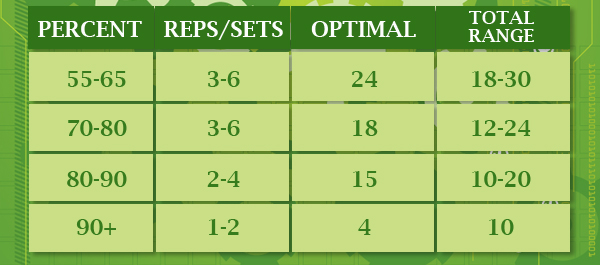
One of the best ways to apply this is to work to a maximum weight for your strength set, followed by using 70-80% for the size-building set(s) and then 60-70% for the endurance set(s). You can also add extra sets at any weight if you’re feeling brave!

Work Your Energy Systems
This one is simple: you have 3 main energy systems that overlap, from fast-twitch (type 2x) to slow-twitch (type 1) fibers and a lot of overlap in the middle (type 2A fibers).
You’re going to want to hit each of them with specific training types that fit their function, as well as working from the fastest to the slowest. Faster twitch fibers fatigue first, so you’re going to need to train them first to make sure they get used.
Fast Twitch fibers are trained using power exercises and they get huge benefits from slow eccentric training. This means you need to be focusing on maximum speed (for the concentric portion) with or without weight. This is why we include slow eccentric squats and RDLs at low reps first. (See this article)
Slow Twitch fibers are all about burning out and putting in the reps when it gets hard. They allow you to switch gears when you’re all out of power and focus on developing endurance. They’re the biggest fibers in the muscles and, while this doesn’t mean they’re going to grow the most, it does make them an indispensable part of your training.
We use occlusion training (wrapping the joint tightly to restrict blood flow to a muscle) to improve the slow-twitch response because it simulates hypoxia – the condition of being low in oxygen that causes endurance-based muscle fibers to improve. Simulating this experience is going to allow you to get the training effects without the waiting necessary if you were to perform a huge burn-out set!

In between these two are 2A fibers that tend to cover everything in the middle – they’re going to benefit from the mid-range sets that focus on getting lots of reps out with relatively heavy weight. They’re the easiest to grow because they do a bit of everything, but it’s important to make sure you push the classical ranges (8-10 reps) to grow.
Lower Body Hypertrophy Training: Sets and Reps
If you’re looking to make the most of your workouts, it’s a good idea to use examples. This lower body hypertrophy session is all about increasing your mass below the belt. It employs plenty of the muscle building science we mentioned above.
Box Jump: 5 sets of 3 reps (Fast twitch first)
Slow-Eccentric Deficit Bulgarian Split Squat: 2 sets of 8 reps (Stretching First, Slow-Eccentric)
Slow-Eccentric Back Squat: 1 set of 3 reps, 1 set of 8 reps, 1 set of 15 reps (Eccentric, Rep Scheme Variety)
Slow-Eccentric Romanian Deadlift: 1 set of 3, 1 set of 8, 1 set of 15 (Slow-Eccentric, Rep Scheme Variety)
Cyclist Squat: 3 sets of 15 reps (Muscular Endurance)
Occluded Single-Leg Press: 3 sets of 15 reps (each) (Occlusion Training)
Closing Remarks
Building muscle is all the rage and one of the most enduring goals for fitness enthusiasts because it’s tough, rewarding, and it has a wide variety of benefits. Hypertrophy (muscle-growth) is one of the best fitness goals because it helps so many people in so many different ways!
This article provides some of the basics of improving your muscle growth using techniques that have been under-employed in the fitness world. It might not be as exciting as the newest nonsense celebrity workout junk, but it’s going to bring amazing, exciting results.
Put some time into training with the methods that are backed by science – you’re going to see better, faster progress than sticking with the same old traditions!
Credits
Planked Dumbbells Rows by StockSnap
Table of Contents

2 thoughts on “Hypertrophy (Training Definition, Sets and Reps, Cutting-Edge Info)”
Comments are closed.