
A Great Natural Yoga and Pilates Mat
I like the Manduka eKO Yoga and Pilates Mat. I’ve been using this mat (and its predecessor) since late 2015. While there are some cool new cork-based mats that I’d like to try sometime soon (cork mats at Amazon), I think the Manduka works very well.
Anyone looking for a more natural mat that has a good mixture between form and function should check out the eKO mat. It works well, and has good grip. It also looks elegant and uses a lot natural materials (though isn’t 100% natural, it has some polyester)
When at home or traveling, I use it for yoga, core work, stretching, prehab and bodyweight workouts. I sometimes use it for taking naps, too.
Pros and Cons
Pros
- Feels great
- Grips well
- Looks elegant
- Nice, thick mat (5mm), though there’s also a 4mm and a 1.5mm.
- Made of mostly of natural substances – rubber (after a couple days the rubber smell goes away), cotton and polyester
- Two length sizes – 71”(6’1”) & 79” (6’9”)
- Cool colors
- Very flexible and sturdy
- Made of high-quality materials
- Manduka avoided known toxic materials and methods (dyes and foaming agents) in the production of this mat
- A good choice for the eco-minded (there are other great products on the market, too)
Manduka eKO Yoga and Pilates Mat, Sage, 5mm, 71″ (Amazon Link -make sure you pick your color and mat length if you’re planning to purchase the mat)
Cons
- Can be a little on the expensive side, though sometimes you can find some on sale. For example, I got my pink mat on extreme sale back in 2015.
- If you dislike the smell of rubber, this could be an issue in the beginning – I just left mine outside for a few days
- Heavier than some mats, which might be an issue for some people (they also have the same mat but 4mm and 1.5mm thick)
- If the back of the mat gets very wet, it can take a day or two to dry out. I had to use a fan recently for about 24 hours before it felt completely dry (after being in the rain)
- This mat isn’t 100% made from natural substance. There’s some polyester used.
Mat Care
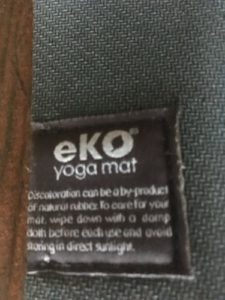
According to the label:
Discoloration can a by-product of natural rubber. To care for your mat, wipe down with a damp cloth before each use and avoid storing in direct sunlight.
Specs
| Dimensions | 26” Wide by 71” or 79” Long. 5mm thick. Other models are 4mm and 1.5mm thick |
| Weight | 7 or 8 lbs, depending on the length |
| Colors | Grey, Blue, Green, Dark Grey, Red, Some multi-colors |
| Materials | Non-Amazon sourced rubber, No PVC or plasticizers, 99% latex free |
The foaming agents used to create the eKO are non-toxic. What this means is that no toxic chemicals have gone into the manufacturing process to soften the rubber. Additionally, instead of using synthetic polyester for reinforcement, we have chosen to use a blend of polyester and natural cotton.

Personal Experience
I’ve tried the current mat (Grey, Manduka eKO Yoga and Pilates Mat (5mm, 79″)) and the older model (Manduka eKO 5mm Natural Rubber Wet-Grip Yoga Mat), purchased in late 2015. I also had their PRO mat (made of synthetic materials – it seemed bit more slippery and was more expensive and 6mm thick). I like the eKO mat better – but the PRO mat was still the 2nd best I’ve tried.
I loved the older model eKO – but unfortunately so did someone else, too. I hope they are doing yoga somewhere and are happy. My first mat was pink and on discount. The current one is grey and wasn’t on discount. I like both. I liked the pink/orange combo, but I was using it outside, so it was getting kind of grubby and had lost some of its grip after a couple of years left on the back porch. It still worked very well though.
The current grey mat is incredible because it’s extra long, so I’m not always worrying about running out of room. I did some stretching in the rain recently, and the mat still had good grip. I would have personally preferred a different color, but I needed a new mat ASAP, and grey was the only color available in the longer size.
I’ve been doing about 15 minutes of yoga/stretching/Pilates a day for almost a year, and the routine seems to be paying off, in terms of flexibility and reduced soreness from playing sports and just general life. (I consider it to be part of my prehab and pre-workout warm up)

Manduka eKO Yoga and Pilates Mat, Sage, 5mm, 71″ (Amazon Link – make sure you pick your color and mat length if you’re planning to purchase the mat)
‘Natural’ vs. ‘Synthetic’
Given currently accepted definitions of natural and synthetic, this mat takes the natural rout while delivering extra levels of performance and product quality. (The eKO doesn’t use 100% natural products – it has some polyester) Of course, ‘natural’ isn’t always necessarily better. In the case of yoga mats, though, I think it might be, at least for me.
Many yoga mats are made from petroleum-based products. And lots of mats don’t hold enough material to protect my knees in certain poses – I end up folding the mat over or using 2. And the substance of the mat sometimes feel a little weird, too.
Isn’t yoga supposed to about getting in touch with nature and stuff? While I’m smelling plastic? I realize that’s a bit snobby, but it’s something to consider, and maybe it’s worth spending an extra 30-50$ if it’s something you’ll use 1-7 days a week for a few years?
Either way, it’s not really a big deal – it’s more like an extra luxury – I still feel good after a session with whatever mat I use (or no mat). And my skin probably protects me from most ‘toxic’ elements, if there are any.
Conclusion
A good mat might actually be cheaper in the long run. If my mat hadn’t grown legs and walked away, I would still be using the original eKO mat 3 years later.
And that’s a mat that’s endured the elements for a couple of years of sun and rain (I would leave it outside to dry out and then forget about it – not advised) Sure it lost a bit of grip, but it still performed well.
What I’m getting at – I might have gone through 2-3 cheaper maps, in the same time period. And maybe had to use 2 at once (not everyone needs the thicker mat size, but I do)
Granted, there’s tons of good quality mats made of plastic and latex that may be cheaper. So, other do options exist.
But if you’re interested in a high-quality mat made with plant-based materials, then put the Manduka eKO Yoga and Pilates Mat on your shortlist (EcoWatch’s and Trusted Clothes’ lists)
Also, if you’re interested in some well-reviewed yoga/Pilates mats made of natural materials, check out some cork-made yoga mat on the market at Amazon! I probably won’t get a second mat for a while, but if I did, I’d probably try a cork-based mat.
Best wishes!